
“Snapchat may not survive”
Those were the words uttered by my Professor, Judy Franks, in my Media Economics class at Northwestern University in early 2015.
The whole class looked at each other with a look of half shock and half humor. Don’t forget, this was the time when Snapchat was thriving. It was all millennials were talking about and doing. We were ‘snapping’ more than texting. It was unthinkable that such an integral part of our lives may not last.
In California at Snapchat HQ (now Snap Inc.), the company was fending off acquisition interest from media giants such as Facebook, and for good reason. It did not need to be acquired. They were growing and thriving like no other media platform ever before it based on a simple value proposition – connecting people who were not in the same place in a manner more intimate and personal than text. Photos.
And while doing so, alleviating the obvious pain point of having to ensure the shared photo was well taken and worrying about seeing it again by having the photo delete itself after a few seconds. This was especially valuable in an era when millennials’ appearance online was everything, with people detagging more photos of themselves than they allowed to stay viewable!
The disappearing photos brought a humorous and often flirtatious nature to Snapchat’s use. Its value proposition was unique and genius and it was dominating one-to-one communication between millennials and friends.
Professor Franks explained to us the importance of a brand in this chaotic media industry while emphasizing that Snapchat was indeed a media company and should be analyzed as such. One of the predictions in her book “Media, from Chaos to Clarity” (a must-read for any marketer), is to ask yourself the following question about any media brand out there:
“If you were to take away the primary channel of that media company, would the brand survive?” If the answer is yes, the brand is healthy. If the answer is no, they need urgent change or they will likely fail.
Take ESPN for example, their primary channel is television. If tomorrow, television ceased to exist, would ESPN survive? The answer is yes. So strong is the ESPN brand that people would consume their media online or via other channels. You can see this happening already with the rise of streaming services such as DIRECTV NOW.
Now, ask the same question about Snapchat and perhaps the situation they are in now isn’t so surprising after all.
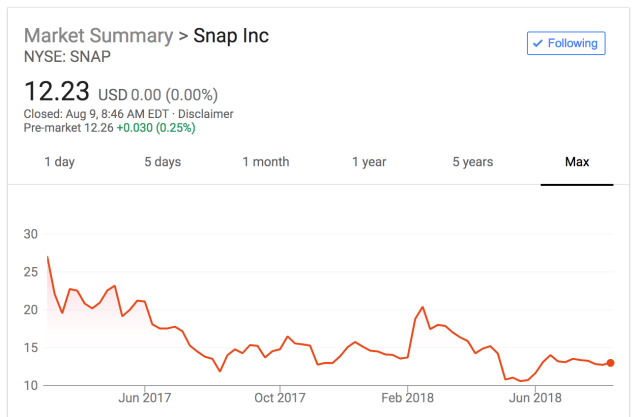
When Facebook acquired Instagram in 2011, they did so because they saw media consumption habits changing and needed to embrace it with a new mobile platform. Whether this acquisition has arguably cannibalized the original Facebook platform and contributed to its downfall (users dropping Facebook for Instagram) will be discussed in another blog, but there was no doubt at the time that this was a solid acquisition of an ever-growing media platform.
At the time, Instagram and Snapchat dominated millennials’ cellphone use with non-competing value propositions.
Snapchat dominated the ‘one-to-one’ communication between users and friends (sending funny photos to friend/s), and Instagram dominated the communication-to-masses. Afterall, Instagram was all about getting users’ content (photos/videos) to as many people as possible – all your friends as well as others interested in similar things on the web.
Then something changed. Snapchat introduced ‘stories’ where snaps were posted to all your friends rather than sent to individuals and Instagram realized they had a better platform to do this and could do it better. And they did. The war for millennials’ ‘go-to’ photo-sharing application had begun.
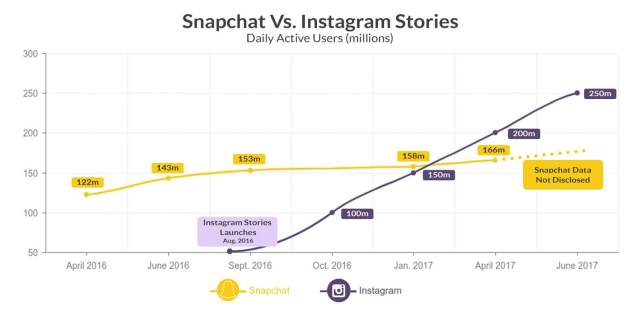
The reason Instagram could do it better was because Snapchat’s brand DNA was built around personalized one-to-one communications. When they added their stories feature, Instagram could easily copy and better this as, because of their connectivity to users’ Facebook profile, people, in general, were connected to FAR more people on Instagram than Snapchat.
A user took a photo they wanted to share and it then came down to a choice of where to post a story. The answer was simple – on the platform where more people would see it. Almost always Instagram. Snapchat had deviated from its roots and entered a territory they could not win.
As more and more people became more invested in Instagram, Instagram introduced features to further kill off Snapchat, such as one-to-one disappearing photos (copying Snapchat’s initial core equity!). Their value propositions had become so similar that there was no need to use both applications and users started choosing one or the other, in most cases Instagram.
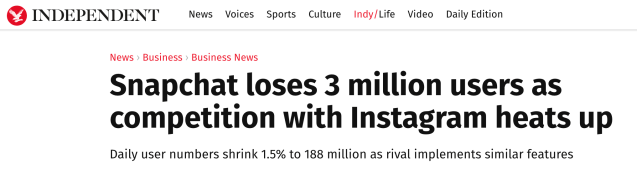
I did my own basic research by posting my same story on both platforms for the first few months of 2018 looking at the number of views each time. Instagram views continuously went up while Snapchat views steadily decreased as more and more people become less invested in the Snapchat platform and dropped the application altogether.
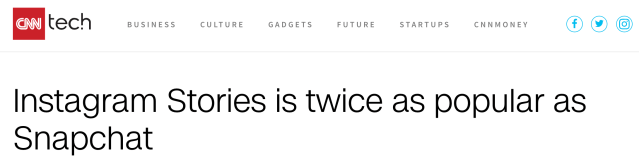
As this continues to be the case, and Snapchat becomes less and less popular, it is hard to see how they will survive.
For me, the way they can survive is going back to their original value proposition and focusing on one-to-one communication. There is still an opportunity there.
Outside of the US, texting is rare and instead, people use WhatsApp (also owned by Facebook) to message each other in a more on-going conversation. Think Blackberry Messenger style.
Snapchat should stop trying to compete with Instagram and instead become the WhatsApp of the US, being the go-to platform for private messages and photos to friends, enticing people to use their platform rather than texting.
Snapchat need to find a way in which, when someone wants to send a message to a friend, they click on Snapchat rather than iMessage in order to do so.
With a solid strategy, can they come back? Yes. Will they? I am unsure and they may need to venture into new territories.
Currently, with millennials dropping the application, Snapchat’s core user base is getting younger and younger. This further adds to their problem of monetizing their platform. These younger users are not high spenders so advertisers are becoming reluctant to use the platform for advertising initiatives.
Compare this to Instagram where, with a combination of a huge user base and users’ Facebook data, advertisers can hyper-target users with high relevant interest and purchase intent, the situation is pretty dire for Snapchat.
A few years on and Professor Frank’s prediction that “Snapchat may not survive” does not look like a bad prediction at all anymore.
 Brand Watch by Alex Keshishian